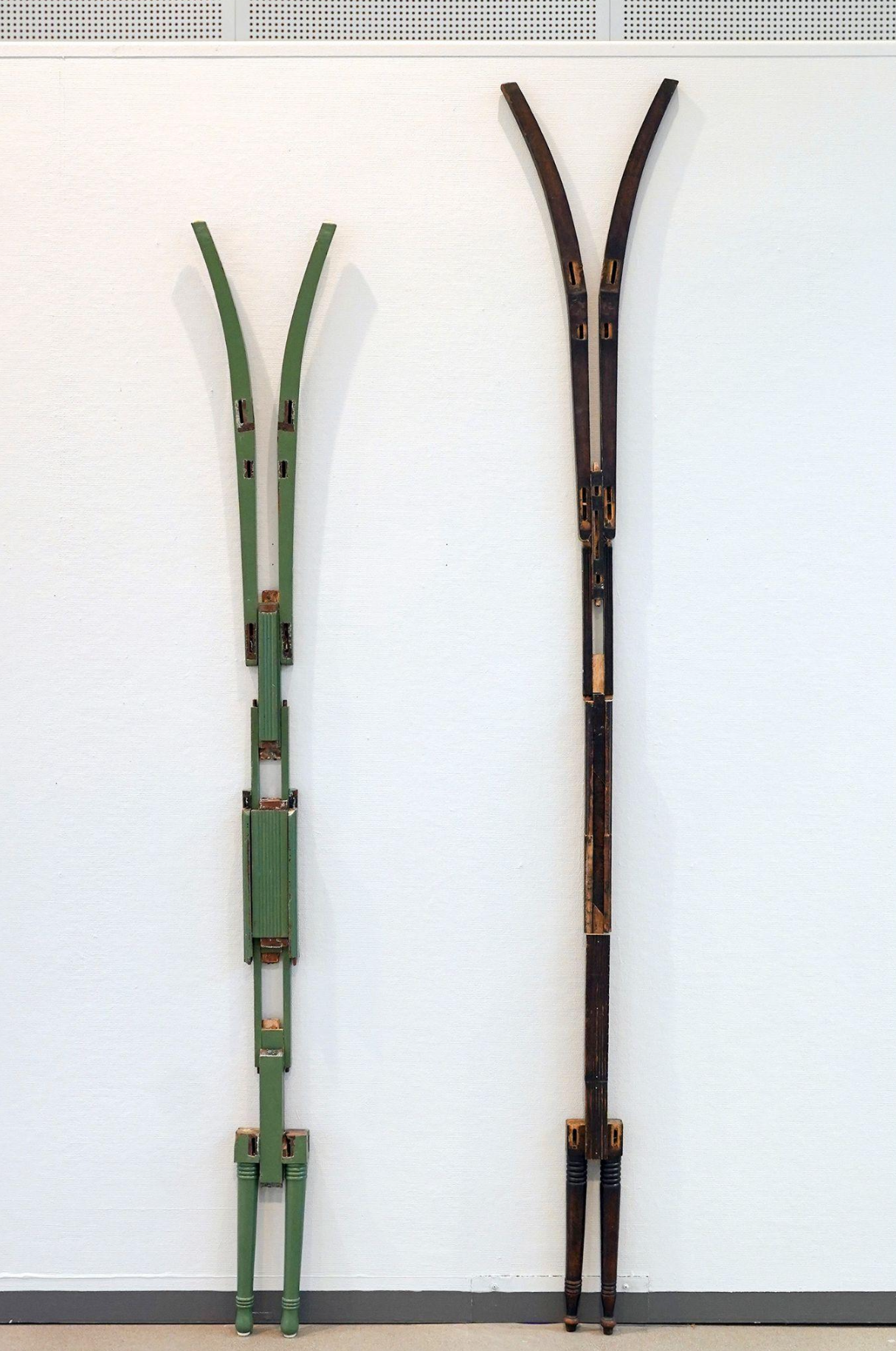
Gränser
May 16 – June 14 Fri 3 - 6 Sat-Sun 12 - 6
A group exhibition exploring boundaries as psychological, political and material constructions.
According to institutions and research reports such as the Pew Research Center, World Values Survey, European Social Survey, Harvard University, and Bertelsmann Stiftung, political, social and cultural polarisation is increasing in a growing number of countries. At the same time, studies in cognitive psychology, political science and media studies show that increased polarisation is associated with a stronger tendency toward black-and-white thinking, characterised by a need for certainty and quick answers, where space for nuance and complex, problematised perspectives diminishes. When convictions are defended, research has shown that the reasons more often stem from an unconscious maintenance of identity, moral values or emotional attachments, rather than from a consistent testing of knowledge — something confirmed in studies where we are asked to present epistemologically coherent reasoning for the distinctions that shape our beliefs, and where we often find it very difficult to do so.
The group exhibition Gränser aims to shed light on how our beliefs are formed, justified and maintained, and what this implies in the long run. The exhibition presents a number of artistic practices and works that engage with different questions under the concept of boundaries. It addresses aesthetic, conceptual, moral and epistemological distinctions, without allowing any of them to take precedence without loss or to be excluded without violence. In this way, the exhibition can be seen as an analogy for the grey complexity that is life.
Curated by Study for Art Platform.
Participating artists: Alina Chaiderov, Cecilia Germain, Christian Andersson, David Altmejd, Elinor Silow, Johan Thurfjell
Karon Nilzén, Mateas Pares, Olof Inger, Peter Johansson, Tobias Bradford, Torbjörn Johansson